SADL
A one-sided, drop-in encoder constraint that acts only when the encoder supplies fewer representation differences than the output demands. It cuts representation collapse over ten seeds from 50% to 0% on LeWM and INTACT, with no auxiliary networks or extra parameters.

SADL (Supply And Demand Loss), new research from the State Key Laboratory of CAD&CG at Zhejiang University and RoboParty Lab, with Alibaba Group, AIR at Tsinghua University and InSpatio, is now released. It starts from a simple question about Joint-Embedding Predictive Architectures (JEPAs): can a well-regularized output still hide an encoder that has degraded?
The answer is yes. From initialization, the encoder representation is dominated by a component shared by different inputs. A batch-normalized projector removes this component, so regularization applied after the projector cannot correct it, and the differences between representations shrink until they collapse. SADL keeps the original training objective and constrains the encoder directly when needed: it compares the representation differences that the projector output demands with the differences the encoder can retain and pass on, and adds a constraint on the encoder only when supply falls short of demand. It introduces no auxiliary networks, no additional trainable parameters and no architectural changes, and it has a single hyperparameter.
In single-task and jointly trained four-task LeWorldModel (LeWM) and INTACT experiments, SADL lowers the collapse rate over ten random seeds from 50% to 0%. After one epoch of training, encoder effective rank is 3.4–6.4× that of the corresponding baseline without SADL, and latent prediction error falls to 1/20–1/303 of it. With several Demand Regularizers, INTACT exceeds 95% mean search-free control success, and on four image datasets SADL also consistently improves accuracy and stability across random seeds.
01 The idea in one film
The three-minute film covers the problem, the method and the main results; the sections below follow the same order.
02 A well-regularized output cannot see what the encoder has lost
At initialization, the encoder representation H is almost entirely one vector shared by every input: sample variation carries about 0.01% of its energy. A batch-normalized projector subtracts the batch mean, so moving all of H along that shared direction leaves the projector output Z unchanged. The Demand Regularizer and the task loss are both computed from Z, so they receive zero gradient in that direction.
The remaining differences between samples keep shrinking until the representation collapses, while Z can still look well-constrained. After one epoch without SADL, sample variation carries only 3.3% of the encoder's energy and 35.5% of the endpoint's; with SADL, the shares are 98.6% and 99.0%.
03 Read the demand at the output, repair the supply at the encoder
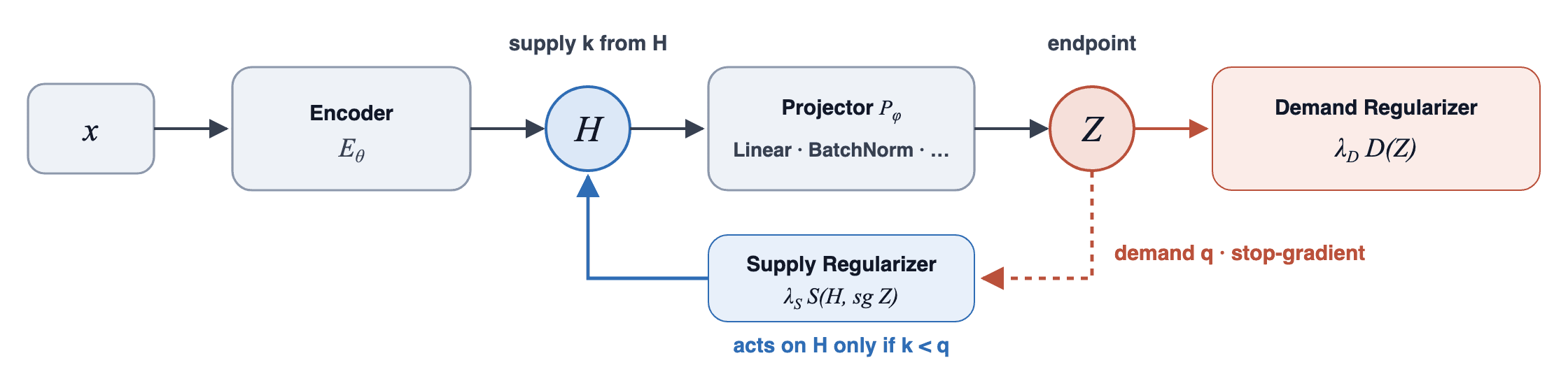
SADL keeps the task loss and the Demand Regularizer unchanged. It reads a detached demand capacity q from Z, measures the supply capacity k of the encoder representation H, and adds a Supply Regularizer on the encoder only when k < q.
Demand capacity: what the output asks for
The demand q is read from Z with stop-gradient and combines two terms: q_reg rises as the Demand Regularizer is satisfied, and q_exc measures the current sample variation at Z. Together, q = √(q_reg · q_exc).
Supply capacity: what the encoder can give
k_exc scores the energy and spread of sample differences in H, and k_tr measures how much of them reaches Z through regularized canonical correlations. The supply is the weaker of the two: k = min{k_exc, k_tr}.
A one-sided Supply Regularizer
The penalty grows with the supply deficit and is exactly zero once supply meets demand, so SADL stays out of the way of a healthy encoder:
S = [log(q + ε) − log(k + ε)]₊².
The full training objective is ℒ = ℒ_task + λ_D·D(Z) + λ_S·S(H, sg Z), where sg denotes stop-gradient, so the correction acts directly on H. SADL adds no trainable parameters or auxiliary networks, and the architecture and inference stay unchanged.
04 Any Demand Regularizer
SADL does not assume a target geometry. With eight Demand Regularizers, including non-Gaussian and density-free ones, INTACT exceeds 92% search-free control success after one epoch, and seven of the eight reach 95.03–95.81%.
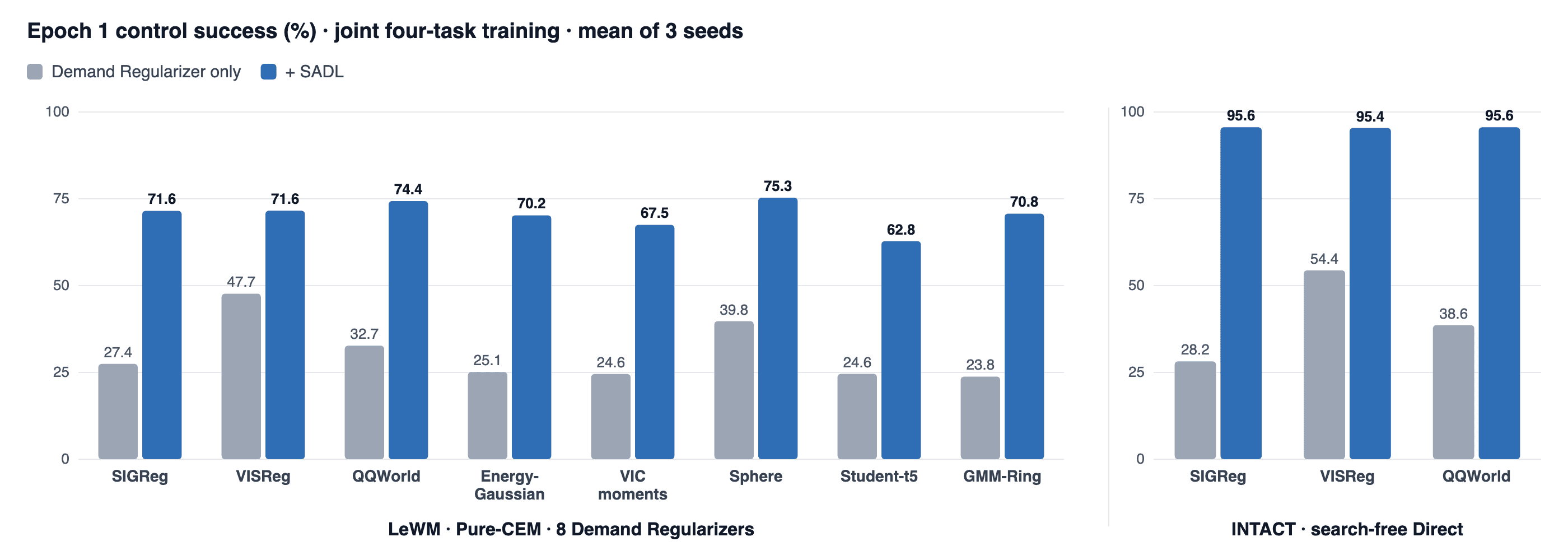
In joint four-task training, LeWM reaches 62.8–75.3% after one epoch with SADL under all eight Demand Regularizers, up from 23.8–47.7% without it. With SIGReg, VISReg and QQWorld, INTACT reaches 95.4–95.6% search-free success, up from 28.2–54.4%. All values are means over three training seeds.
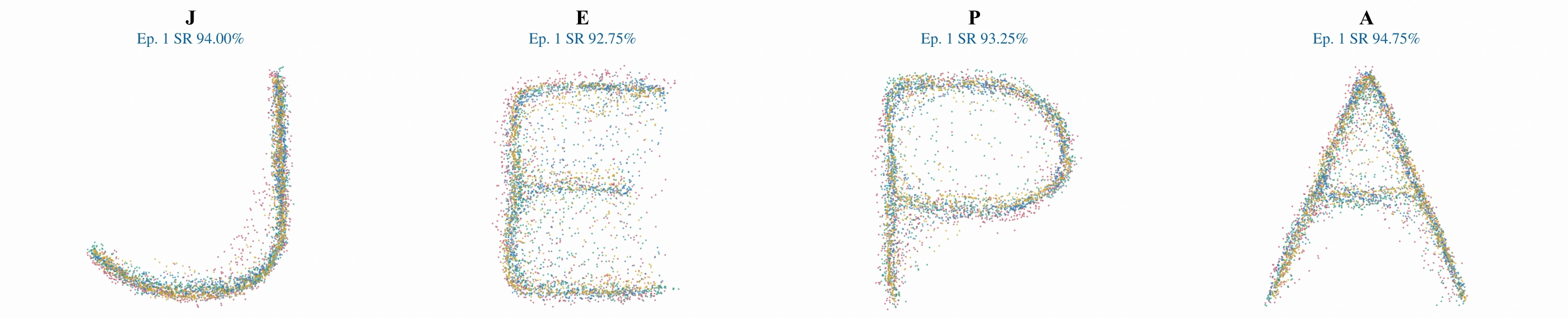
The demanded geometry does not even have to be a distribution. Separately trained glyph targets shape the endpoint latents into the letters J, E, P and A, and still reach 92.75–94.75% control success after one epoch.
05 One epoch with SADL beats two epochs without it
LeWM and INTACT were trained jointly on PushT, Cube, Reacher and TwoRoom. Within each pair, the attention backend, update budget and evaluation are matched; the baseline keeps the task loss and SIGReg, with no SADL term.
Across single-task and four-task LeWM and INTACT, SADL lowers the collapse rate over ten random seeds from 50% to 0%. LeWM's encoder effective rank after one epoch rises from 14.5 to 52.7. At epoch two, INTACT with SADL reaches 96.3% four-task mean control success with either MATH or Flash attention, against 70.0% and 66.1% for the baseline.
06 Reopening an encoder that has already collapsed
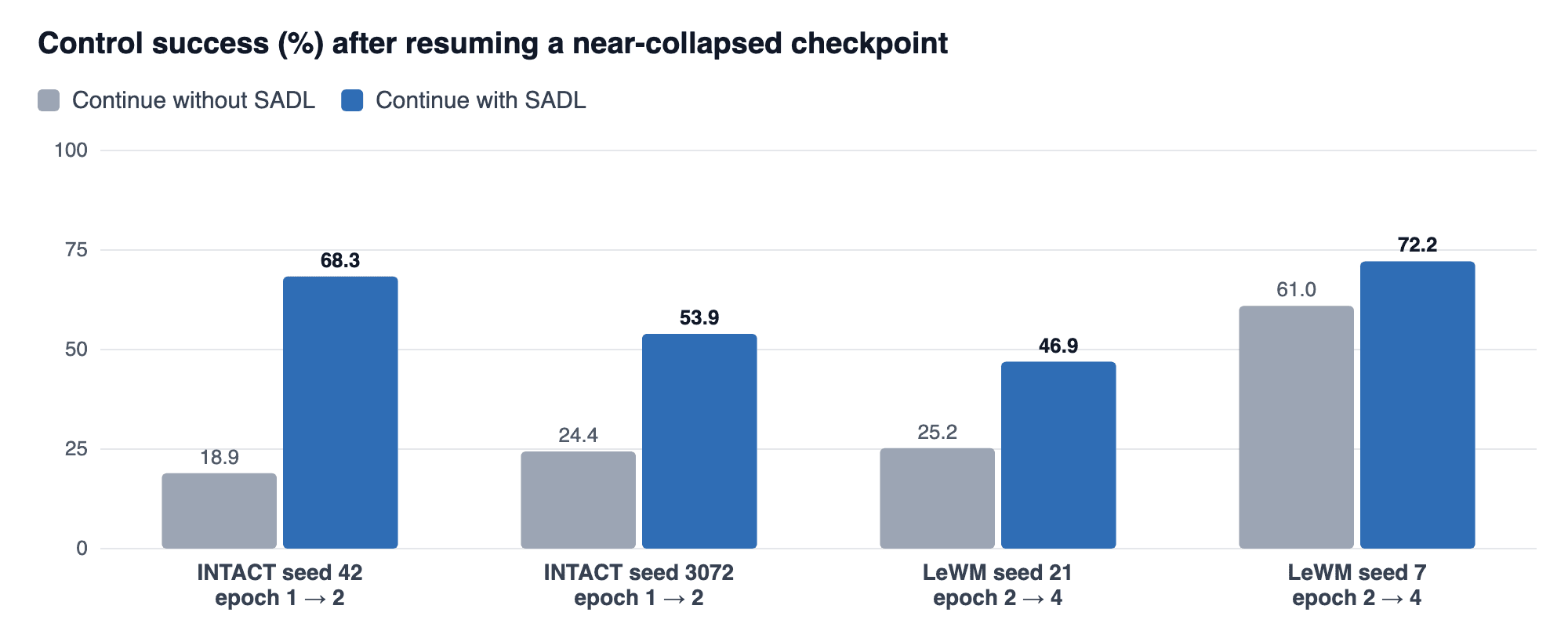
SADL can also rescue an encoder that has already collapsed. Starting from fixed near-collapsed checkpoints, training resumes either with the original Demand Regularizer only or with SADL added at its default weight λ_S = 0.01. After one more epoch, INTACT seed 42 reaches 68.3% control success with SADL, against 18.9% without it; replicated on a second machine, the result is 69.1% against 23.1%.
The gain holds on other checkpoints: 29.5 points for INTACT seed 3072 (53.9% against 24.4%), and 21.7 points for LeWM seed 21 from epoch 2 to epoch 4.
07 Beyond control: faster image representation learning
The same loss also speeds up image representation learning. On ImageNet-LT, Galaxy10, CIFAR-10 and Imagenette, under matched budgets and Demand Regularizers, SADL improves early learning on all four datasets.
On Imagenette, SADL gains 8.91 points at epoch 20; the gap narrows to 0.44 points by epoch 800. It reaches the baseline's final accuracy with 23% fewer updates (17.8k against 23.2k, median of three seeds). On ImageNet-LT, it reaches 90% of the baseline's final accuracy with 10% fewer updates (31.2k against 34.8k).
08 Stabilizing mainstream self-supervised learning
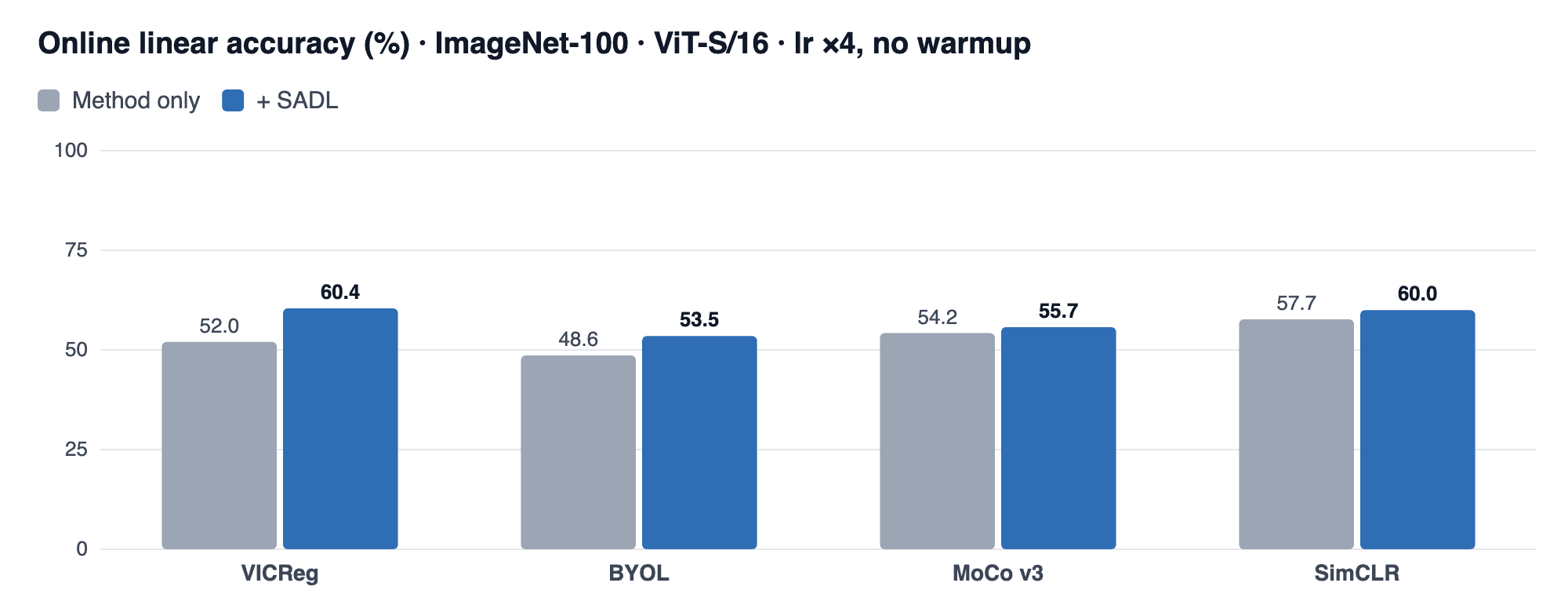
SADL also works as a drop-in addition to standard self-supervised objectives. VICReg, BYOL, MoCo v3 and SimCLR were trained on ImageNet-100 with ViT-S/16 under an aggressive recipe, four times the learning rate and no warmup, where training becomes unstable. SADL was added with no other change.
VICReg's online linear accuracy rises by 8.4 points (52.0% to 60.4%), with kNN accuracy up 7.8 points. BYOL rises by 4.9 points (48.6% to 53.5%), with the linear probe up 3.4 points. At the end of training, the share of VICReg encoder energy carried by sample variation rises from 0.38 to 0.99.
Code, checkpoints and authors
The training and evaluation code for INTACT and LeWM world models with SADL is open source under the MIT license on GitHub, and checkpoints and the four task datasets are on Hugging Face. The paper is available on arXiv.
Authors: Junhan Sun, Yigui Feng, Mingzhe Liu, Haoyan Xu, Lei Ye, Ziqi Han, Hanru Bai, Yanzhao Zhang, Hao Zhao and Guofeng Zhang. Hao Zhao and Guofeng Zhang are the corresponding authors.