PartyMimic
A model-based tracker that trains one whole-body policy on a 41-hour motion library in 28 minutes on one RTX 4090, and tracks unseen motions on Unitree G1 and RoboParty RP1 with the lowest mean error of every method compared.

PartyMimic, new open-source work from RoboParty Lab, brings general humanoid motion tracking down to minutes on a single GPU. One whole-body tracking policy learns a 41-hour motion library in 28 minutes on one RTX 4090 (24 GB) and tracks motions it has never seen, on both the Unitree G1 and RoboParty's open-source humanoid RP1.
PartyMimic is a model-based learner in the SuperMimic family. It fits an online world model, trains the policy by backpropagating through 32 imagined steps of that model, and uses a critic beyond the imagination horizon. On five held-out test sets, from locomotion and manipulation to dance, ground motions and extreme martial arts, it has the lowest mean error of every method compared, including official policies trained with far more compute.
The repository releases the method in full: the training code, the data recipe, including kneeling and crawling clips recorded at RoboParty, the RP1 retargeting, the diversity analysis and the evaluation, together with trained checkpoints for G1 and RP1.
01 One tracking policy in minutes
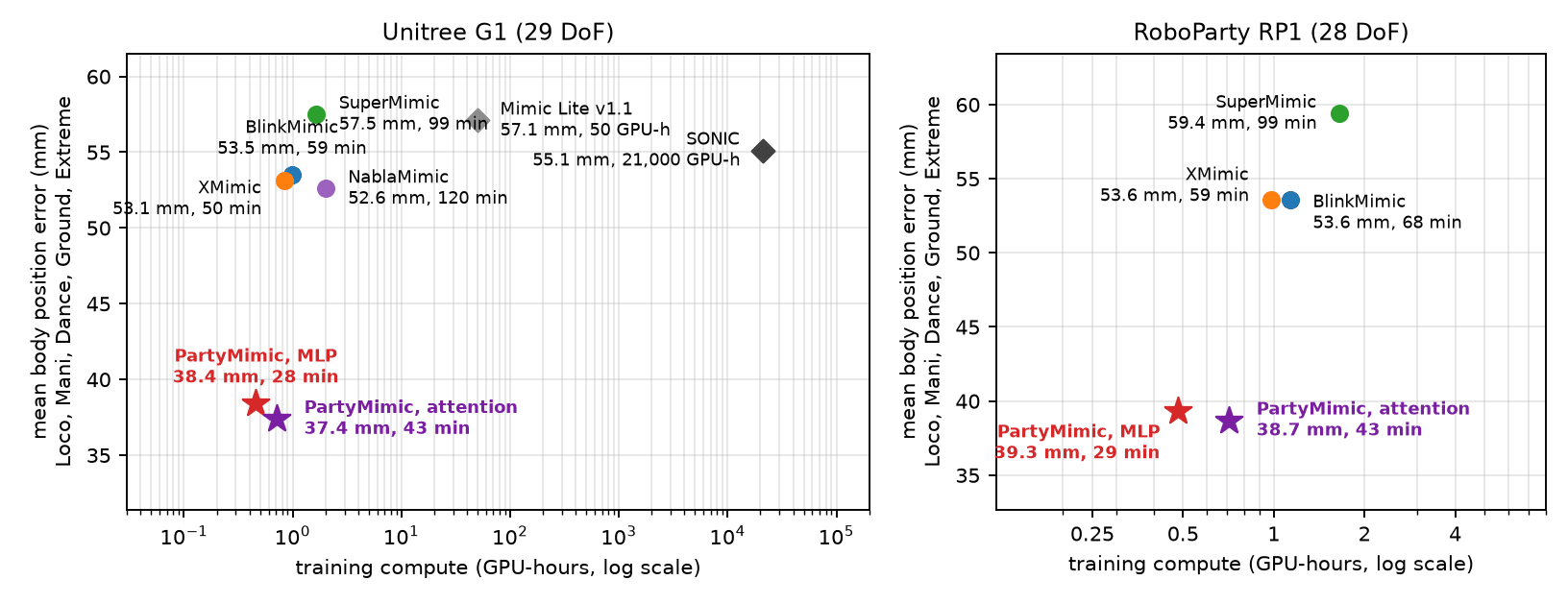
PartyMimic trains on the full 10,745-clip library in 28 minutes on one RTX 4090 for G1 and 29 minutes for RP1; the cross-attention variant takes 43 minutes. Other methods trained on the same data and GPU took 50 to 120 minutes, and the official policies in the comparison were trained with 50 GPU-hours (Mimic Lite v1.1) and 21,000 GPU-hours (SONIC).
The shorter training does not cost precision. Over the five held-out test sets, the mean body position error is 38.4 mm on G1 (37.4 mm with attention), against 52.6 to 57.5 mm for every other method, SONIC at 55.1 mm included. On RP1 it is 39.3 mm (38.7 mm with attention), against 53.6 to 59.4 mm. On held-out manipulation clips PartyMimic reaches 21.4 mm on G1 and 16.3 mm on RP1, 24% and 42% below the best other method.
02 Tested on motions it has never seen
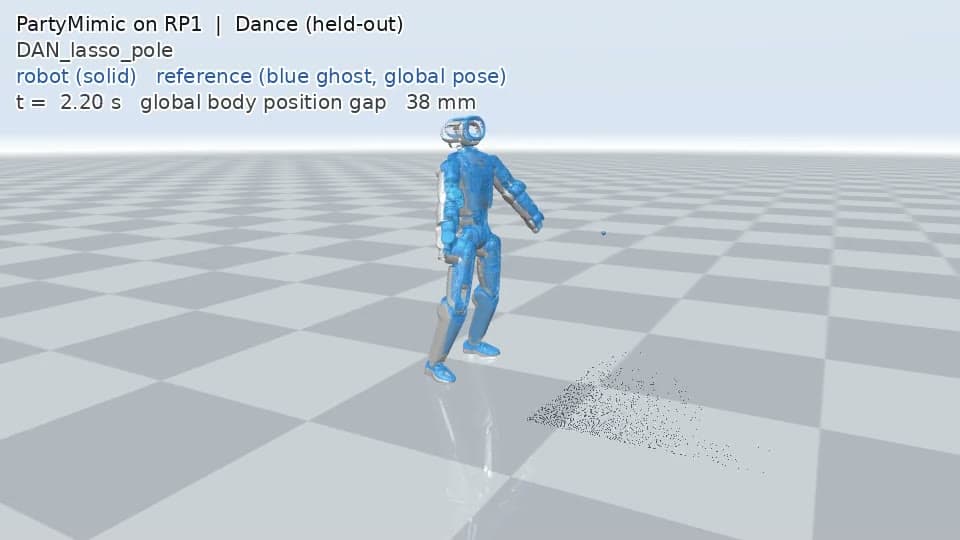
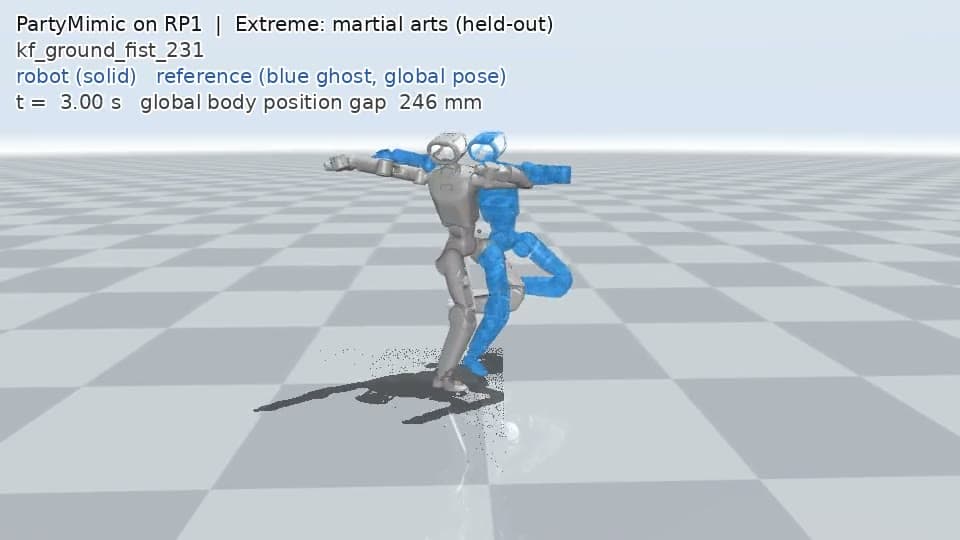
Every method is trained on the same 10,745 clips and tested on five held-out sets: Loco (80 clips), Mani (48), Dance (40) and Ground (60) from MotionDecode, a different motion-capture source, and Extreme, 308 KungfuAthlete clips of martial arts, jumps and flips held out by whole source video. Each method trains for 12,000 iterations on one RTX 4090 (NablaMimic for its two-hour budget), with two seeds. Scoring uses the MuJoCo sim2sim evaluator of the sim2real leaderboard after ONNX export, with every clip played from its first frame to its end.
On the hardest set, Extreme, the strict success rate counts clips played to the end without the pelvis orientation error staying above 57° for 0.2 s. PartyMimic with attention reaches 74.4% on G1 and 73.2% on RP1, close to the best baselines (74.8% and 76.5%), while its body error on these clips is about 25 mm lower than the best of them.
03 41 hours of diverse motion
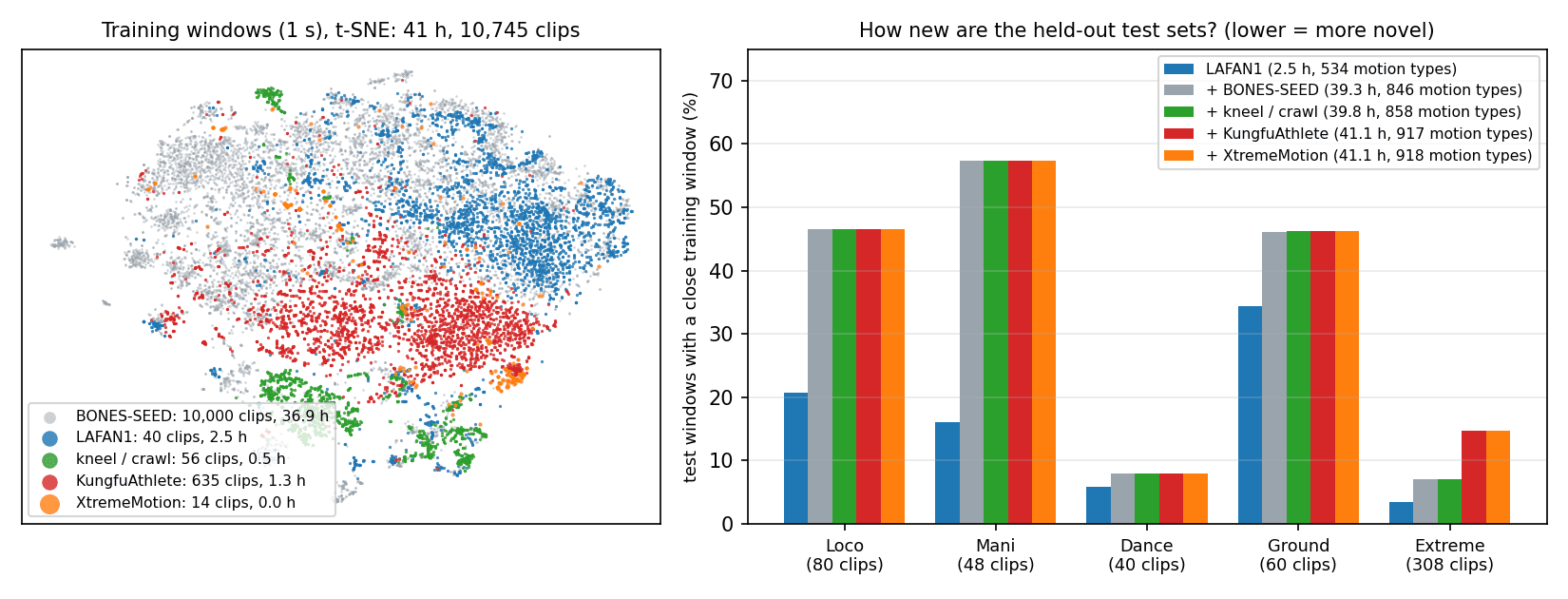
The training library combines LAFAN1, a 10,000-clip diversity-selected subset of BONES-SEED, 635 KungfuAthlete clips, 14 XtremeMotion clips and 56 kneeling and crawling clips recorded at RoboParty, which ship in the repository. The same clips are retargeted from G1 to RP1 with the robot-to-robot IK of Human-Humanoid Tools.
Diversity is measured rather than assumed. Every one-second window is described by heading-invariant root, joint, hand and foot kinematics, projected to 32 dimensions and clustered into 2,000 motion clusters; the library covers 918 distinct motion types. The BONES-SEED subset is chosen the same way, filling the clusters evenly before any motion repeats. The test sets stay genuinely new: 92% of the Dance windows and 85% of the Extreme windows have no close match in training.
04 Two architectures, two interfaces
MLP or attention
The default MLP reference encoder is the fastest and fits a standard 24 GB card. A cross-attention encoder is the most precise, with a 37.4 mm mean on G1 and the lowest errors on Dance, Ground and Extreme, for about 1.6 times the training time.
Five keypoints instead of joint angles
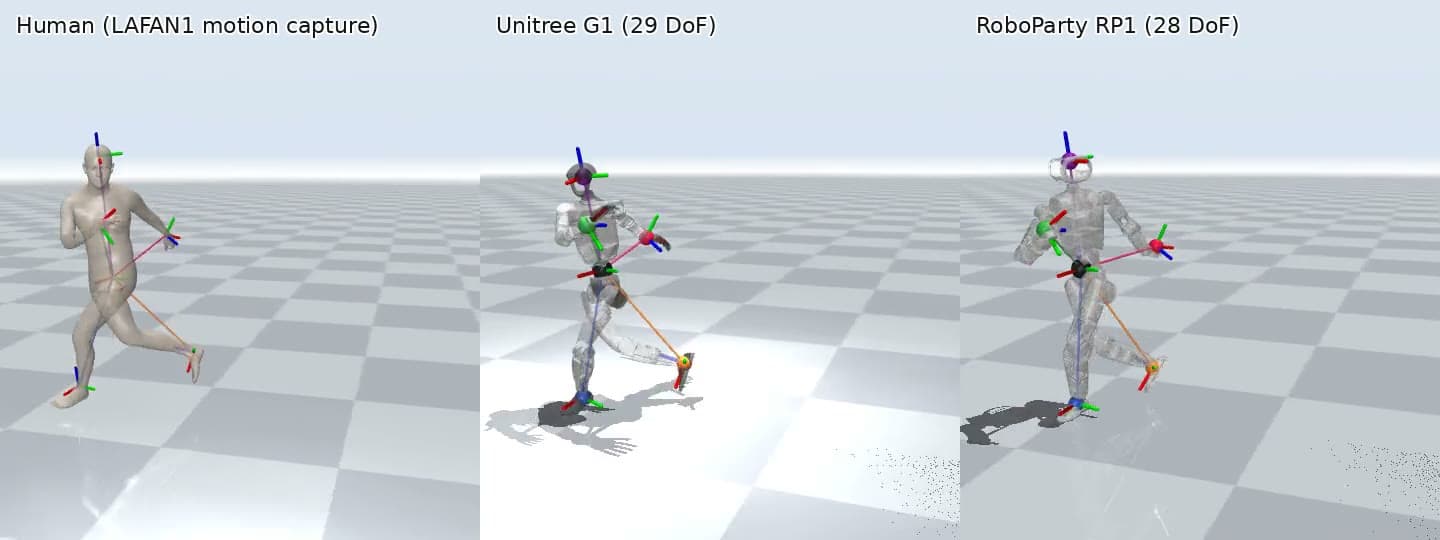
With the sparse interface, the policy receives only the poses of the pelvis, head, wrists and ankles, with no joint angles. The same command format can come from a person, a set of VR trackers or another robot, without retargeting to joints. From these five keypoints RP1 still reaches a 42.3 mm mean, below every baseline that is given the full joint reference (53.6 mm).
05 Tracking motions performed on something
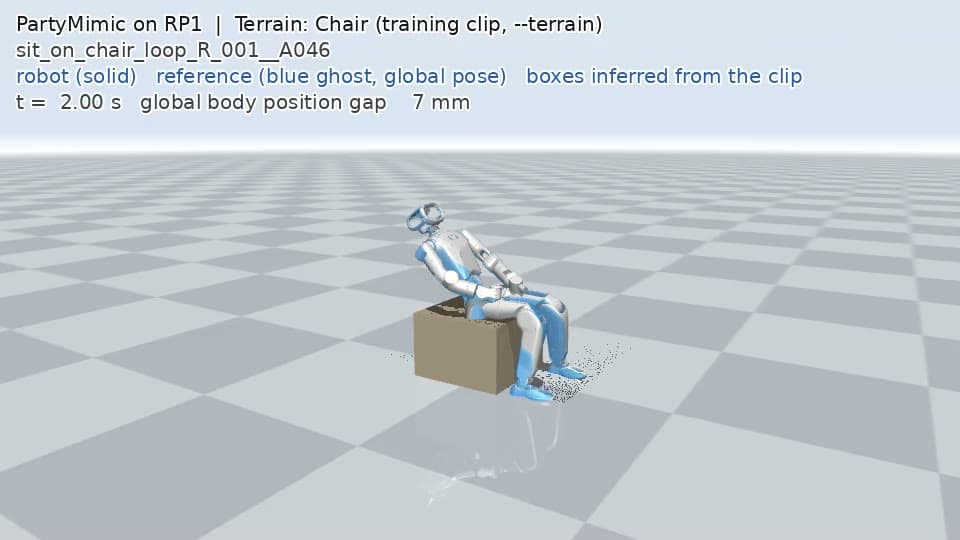
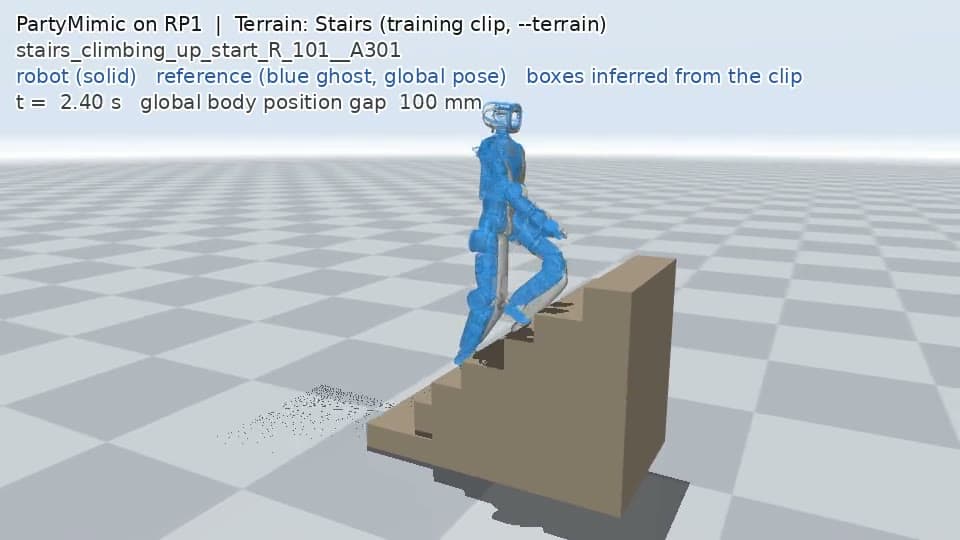
Many motion clips are performed on something: a 50 cm box, a chair, stairs, a wall or a ladder. On flat ground they cannot be tracked. PartyMimic's terrain mode plays every clip through the robot's own model, reads the supports off its contacts, gives the clip the static boxes it needs and checks them physically before training. The world model and the critic see a height scan around the robot, while the policy stays blind and reads the terrain from its reference alone, so the deployed inputs are unchanged.
On the full filtered BONES-SEED, 99% of all clips succeed after 3,000 iterations: 129,205 G1 clips in 13 minutes and 127,702 RP1 clips in 20 minutes on one RTX 4090, where training without terrain stays at about 96.8%. Longer runs reach 99.80% on G1 and 99.57% on RP1. Stairs and ladders remain the hardest cases.
06 What makes it learn fast
PartyMimic learns from a world model it fits online. The policy is trained by backpropagating through 32 imagined steps of that model, and a critic covers the return beyond the horizon. Ablations on G1 held-out locomotion and manipulation show what matters most: replacing the Muon optimizer with Adam adds 10.7 mm of error, halving the imagination horizon to 16 steps adds 5.9 mm, removing the reference-action skip adds 5.6 mm and removing the policy EMA adds 3.4 mm.
Long runs need guards as well. Clipping the critic's value and skipping world-model or critic updates whose loss spikes keep training stable far beyond 12,000 iterations, up to 320,000.
07 From simulation to real robots
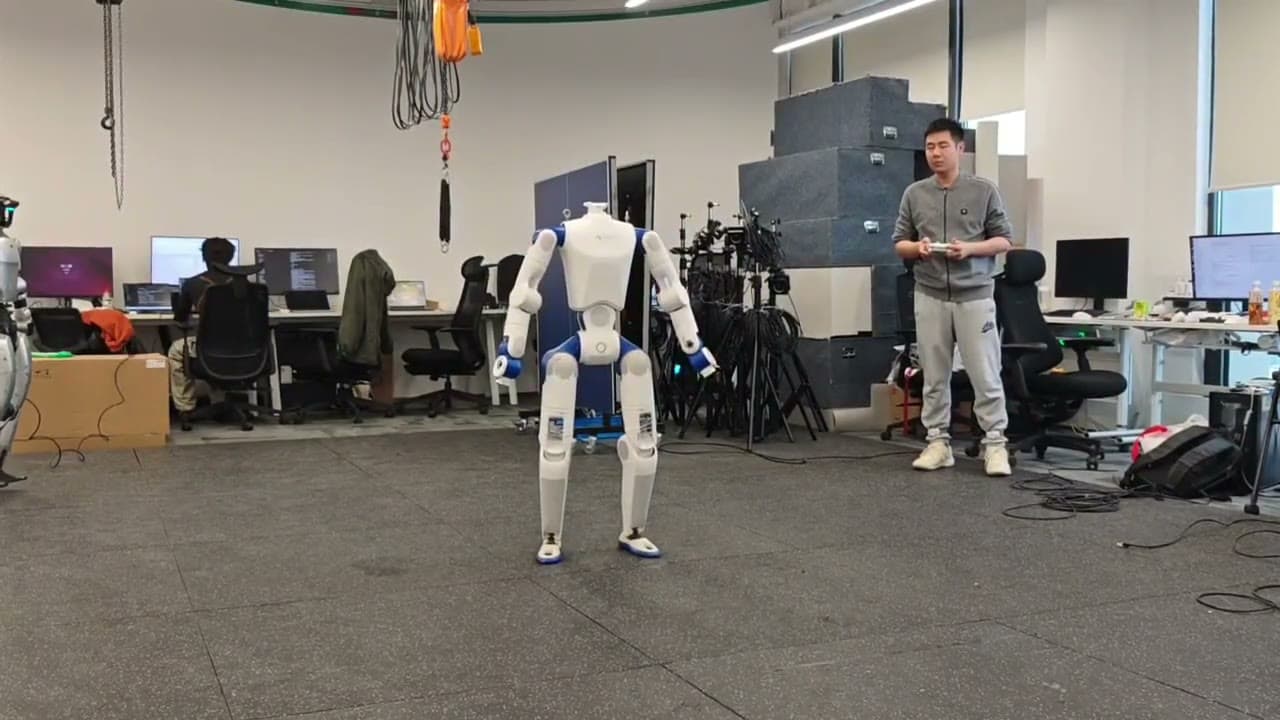
Deployment stacks deliver joint targets late. A policy trained without that delay turns it into ankle chatter and foot slip, so PartyMimic's defaults train with a command lag of 5 to 20 ms. On RP1 under a realistic deployment latency, the lag alone cuts ankle chatter from 1.40° to 0.63°, and the full deployment defaults bring it to 0.39°, with joint-target jerk down from 109 to 27 rad/s² and foot slip from 3.75 to 1.03 cm/s.
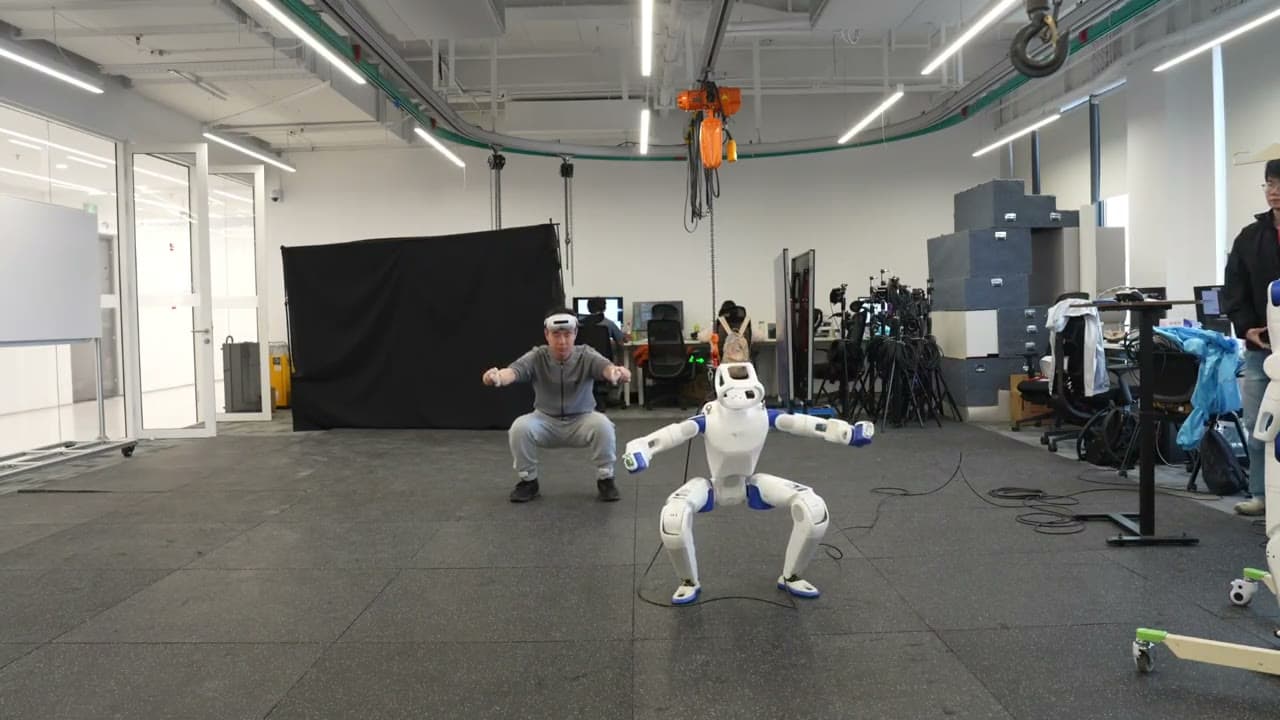
The hands often carry something the policy cannot see. A narrower wrist reward, the keypoint error as a policy input and a hidden wrist payload of up to 2 kg in training cut the wrist error under a 2 kg load from about 56 to 19 mm on G1 and from 57 to 16 mm on RP1. PartyMimic policies run on the physical robots: G1 sits down, stands up and performs fine manipulation, and RP1 performs a backflip and follows a teleoperator.
08 Inside Party OS
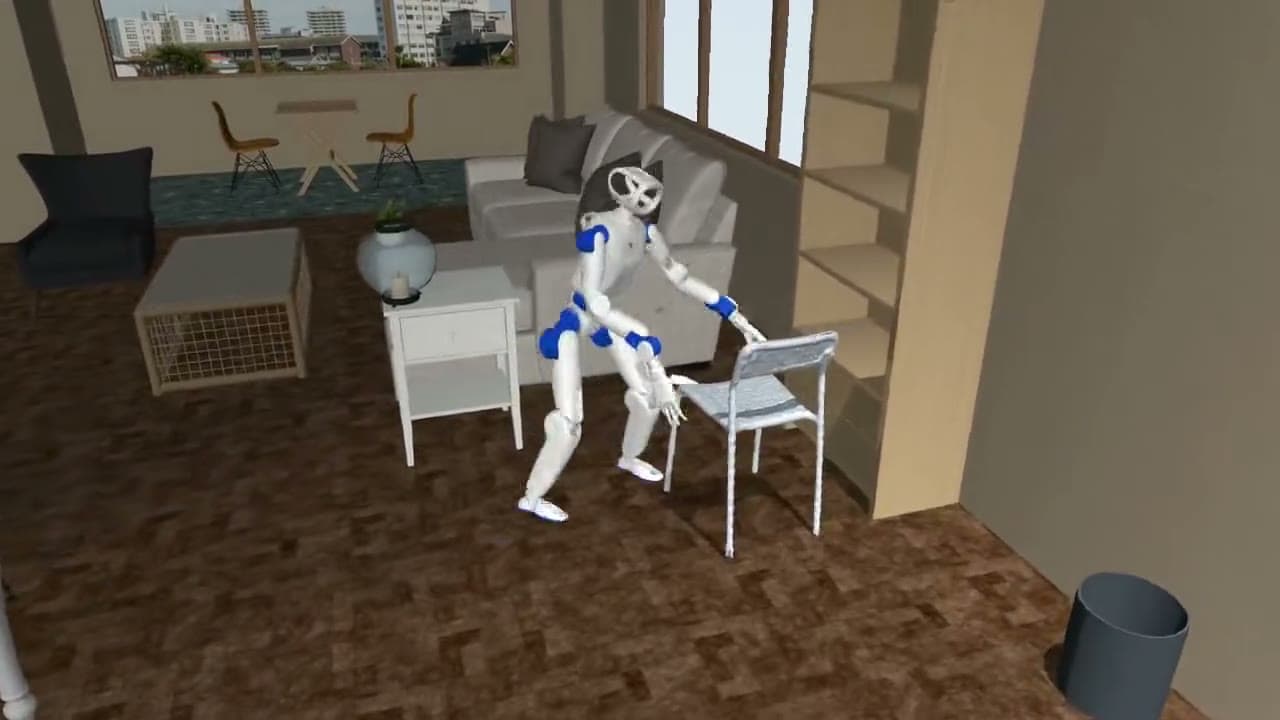
Inside RoboParty, PartyMimic already runs as the whole-body controller under the task agent INTACT. Task data comes from R2S, which builds an editable simulation scene from one RGB photo, followed by motion generation and PartyMimic; fewer than 10 clips per task are enough, and INTACT then trains in about 20 minutes. Tasks include putting a bottle into the fridge, carrying a can to the bin, unscrewing a bottle cap, moving a chair and climbing steps to pick up a bottle.
The sparse keypoint interface also lets a planner command the robot directly. A vision-language model running locally sees the head camera and calls skills such as walking, picking and placing; a middle layer turns them into a 50 Hz stream of future keypoints, and the RP1 terrain policy tracks it. Carrying a box from one table to another, it succeeds in 14 of 20 closed-loop episodes.
Open to everyone
PartyMimic is released under the MIT License. The repository contains the training code, the data recipe and our kneeling and crawling clips, the RP1 retargeting, the diversity analysis, the evaluation and export tools, and trained checkpoints for G1 and RP1 that export to ONNX for sim2sim and real-robot deployment. It builds on BlinkMimic, InstantTrack and SuperMimic, on mjlab and MuJoCo Warp, and is evaluated with the sim2real leaderboard.